
Design and implementation of a generic MLOps Platform


Our Business and Information Analysts act as a bridge between your business operations and IT. They analyze and optimize your business processes to improve your information provision and generate business value for you. They gather and translate the needs of your stakeholders into clear requirements and concrete solutions. Their analytical and communication skills contribute to effective change within your organization.

Our analysts work according to the LEAN principle and organize business processes as efficiently as possible. They use an Agile approach to quickly develop usable functionalities. We combine these methodologies with best practices such as Value Stream Mapping, Business Capability Modeling, Business Process Modeling, TOGAF, Agile/Scrum, and DevOps. This enables us to provide high-quality solutions that meet the needs of our customers.
Whether we are implementing case-based working for government agencies, developing a new permitting system for the Environment and Planning Act, or guiding new services and processes in the financial sector, our Business and Information Analysts always provide the expertise and guidance needed to successfully address these challenges.
Curious what this looks like in practice? Watch the video in which our colleague Mieke talks about her work as an Information Analyst.
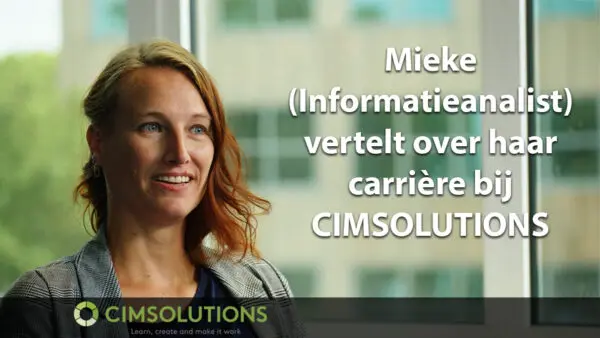
My name is Mieke. I’ve been working for CIMSOLUTIONS at the Amsterdam office since 2015. I started as a functional manager and now I work as an information analyst.
I studied mathematics as a teacher and then taught math for five years in high school. At one point, I thought, what else can I do? After some temporary work, I went to an open house here in Amsterdam, and I think I landed a job three hours later, after many interviews with managers.
I started at CIMSOLUTIONS as a functional manager, but I had already done some assignments as an information analyst. However, I didn’t have any training in that field, so I started looking into certifications at CIMSOLUTIONS. What do you need to become an information analyst? That’s how I progressed. I’d like to progress to business analyst or architect. Yes, anything is possible at CIMSOLUTIONS.
What I really like about secondment is that you work somewhere for a year or so until an assignment is over, and then you can start over. Now I’m realizing that working somewhere for a longer period is actually also really beneficial, because you know who to contact and for what kind of questions. It’s also fun to get to know your team better and go to company parties.
My current assignment is for a central government organization, where we’re setting up a new digital archive. Over the past twenty years, new laws have been introduced, and that’s affecting how the government is supposed to store things. As an information analyst, I’m the link between users and programmers. I’m working on developing user requirements and then working that out into user stories, so the developers can work on them in the next sprint.
I’m part of the Competence Center for Business Analysis and Information Analysis. There, you work with colleagues who have the same role as you. And when you join as a junior, you talk to colleagues who have been doing this for thirty years. Besides the fact that, because you’ve already met them, you can call or email them with other questions later, it’s also really nice to sit down together for an hour or two every now and then. And at CIMSOLUTIONS, you receive tremendous support from the account managers, your field manager, and your other colleagues.
So if you’d like that too, come join me at CIMSOLUTIONS.
We offer our expertise in various sectors, including government and business services. Our specialists actively share their knowledge through the Special Interest Group “Business and Information Analysis,” the Competence Center Business Analysis, publications, guest lectures, and our own CIMposium for clients and relations.